← Back to Blog
tips
Documents for Studying in China 2026: Complete Checklist
By Foorsa Team
May 14, 2026
34 views
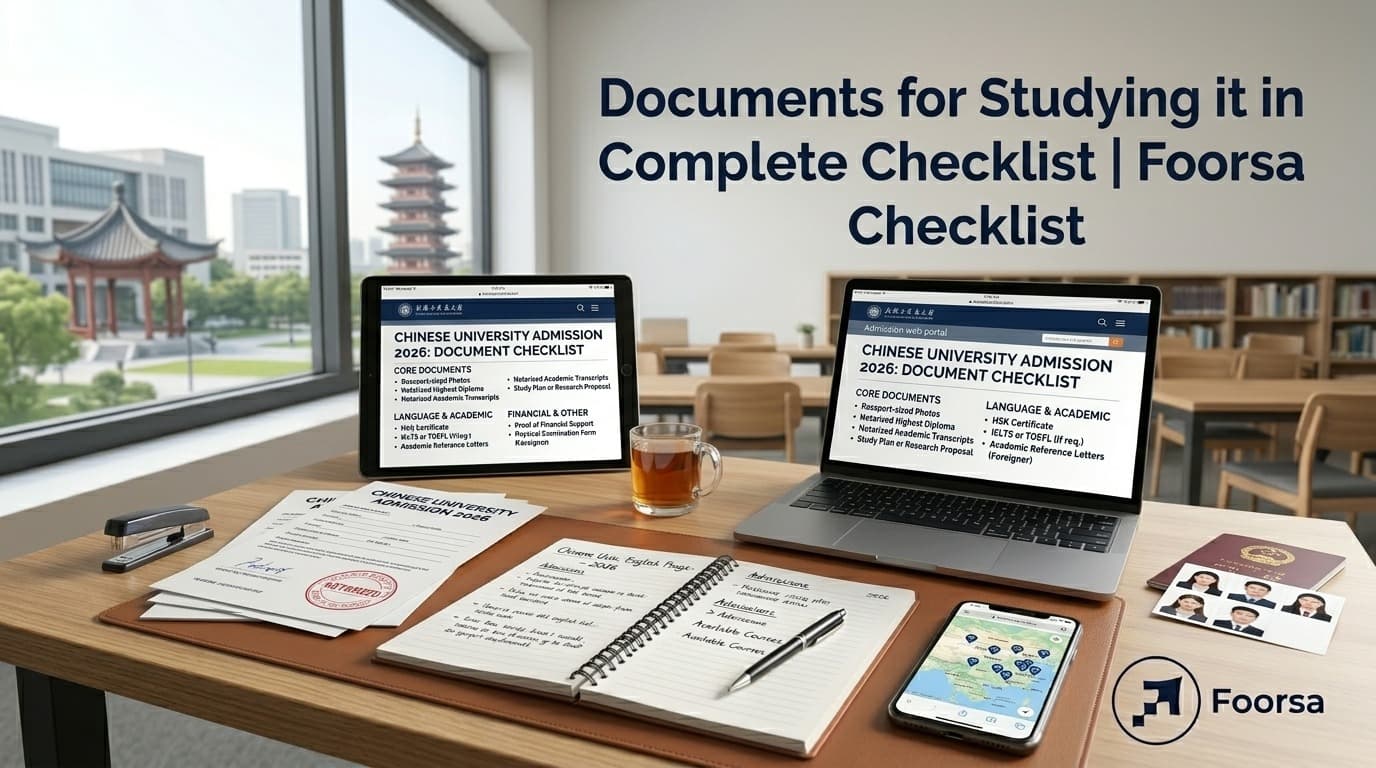
Documents for Studying in China 2026: Complete Checklist for Moroccan Students
Getting your documents right is the single most controllable factor in your China university application. Academic qualifications open the door — but a complete, correctly prepared document file is what gets you through it. Every year, Foorsa sees strong candidates lose their place at excellent Chinese universities not because of poor grades, but because of missing, expired or incorrectly prepared documents.
This complete checklist covers every document required for every level of study, with exact specifications, common mistakes and insider tips for making your application file stand out. For the official CSC scholarship application platform, visit study.csc.edu.cn directly.
Why Document Quality Matters More Than Most Students Think
| Document Issue | How Common | Impact on Application |
| Generic Study Plan not tailored to the university | Very common | Critical — most important document in the file |
| Missing or low-quality self-introduction video | Common | High — competitive advantage most applicants miss |
| Untranslated or uncertified academic documents | Common | Automatic rejection |
| Generic recommendation letters | Very common | Medium to high negative impact |
| Expired or non-Chinese health certificate | Common | Automatic rejection |
| Applying to only one university | Very common | Severely reduces overall acceptance chances |
| Non-compliant passport photos | Less common | Medium — causes delays or rejection |
Complete Document Checklist by Study Level
Bachelor's Degree — 16 Documents
| Document | Exact Specifications | Competitive Value |
| National ID card | Color copy — both sides | Administrative |
| Parents' national ID cards | Two color copies — both sides | Administrative |
| Passport | Full color copy — minimum 18 months validity | Administrative — critical |
| Baccalaureate diploma + full transcript | Original + certified English translation | Administrative — essential |
| Academic CV | In English — professional format — highlight achievements | Competitive — medium |
| Study Plan | 800+ words in English — customized per university | Competitive — very high |
| Self-introduction video | 3 minutes — high quality — compelling content | Competitive — very high |
| Chinese official health certificate | Chinese government form only — 6-month validity | Administrative — critical |
| Good conduct certificate | Translated and notarized — 3-month validity | Administrative — critical |
| CSCA exam result | Required at 306+ universities since 2026 | Administrative — critical |
| English proficiency certificate (IELTS/TOEFL) | Optional but significantly strengthens application | Competitive — high |
| Two academic recommendation letters | From professors in target field of study | Competitive — high |
| Email address | Professional, active email address | Administrative |
| Anthropometric record | From approved doctor or hospital | Administrative |
| 3 professional passport photos | White background — passport size — recent | Administrative |
| Parents' phone numbers | Two active contact numbers | Administrative |
Master's Degree — Additional Documents
| Additional Document | Specifications | Notes |
| Bachelor's degree diploma | Original + certified English translation + full transcript | All pages of transcript required |
| Supervisor acceptance letter | From professor at target university | Essential for research Master's — see section below |
| Research Proposal | 3 to 4 pages in English | Most discriminating document in Master's applications |
PhD / Doctorate — Additional Documents
| Additional Document | Specifications | Notes |
| Bachelor's AND Master's diplomas | Both originals + certified English translations + transcripts | All transcripts required |
| Supervisor acceptance letter | From professor at target university — formal letter on letterhead | Mandatory before formal application |
| Research Proposal | 4 to 6 pages in English with full bibliography | The most critical document in a doctoral application |
| List of publications (if any) | Copies of published or submitted papers | Major differentiator — include even conference papers |
The Study Plan — Your Most Important Competitive Document
| The reality most applicants don't know: Chinese university admissions officers read the Study Plan first — before any other document. It determines whether they continue reading your file at all. |
A winning Study Plan is not a summary of your CV. It is a targeted persuasion letter addressed to a specific university explaining exactly why you are an exceptional candidate for their specific program:
| Study Plan Section | Required Content | Recommended Length |
| Opening hook | An attention-grabbing opening line — not 'I want to study in China' | 2 to 3 sentences |
| Academic background | Highlight your key achievements — link them to the target field | 100 to 150 words |
| Why this field? | Your genuine motivations — connect to Moroccan or African context | 100 to 150 words |
| Why China specifically? | Cite China's specific strengths in your field with data — avoid generic praise | 80 to 120 words |
| Why this university specifically? | Name a specific professor, lab or program — shows genuine research | 80 to 120 words |
| Your study plan | How you will use the program — what you will learn and apply | 100 to 150 words |
| Post-graduation project | What you will do after returning to Morocco — be specific and realistic | 100 to 150 words |
| Closing | A confident closing expressing genuine commitment and gratitude | 2 to 3 sentences |
| Critical Study Plan mistakes to avoid: ✗ 'I love China and its culture' — this is not a reason for admission ✗ Copying the same text to every university without customization ✗ Focusing entirely on the past without presenting a future vision ✗ Exceeding 1,000 words — length does not mean quality ✗ Grammar errors in English — always get a language review before submitting |
Self-Introduction Video — Your Strongest Competitive Advantage
The self-introduction video is the document that over 60% of applicants skip or submit poorly — which is exactly why it is your strongest competitive advantage when done well:
| Minute | Content | Practical Tips |
| Minute 1 (0:00–1:00) | Brief introduction: your name, city, current studies and target specialization | Speak with confidence and a natural smile — do not read from notes — look directly at the camera |
| Minute 2 (1:00–2:00) | Why you chose this field and this specific university | Be specific — name the university — show that you researched it |
| Minute 3 (2:00–3:00) | Your post-graduation project and how you will contribute to Morocco | Close with a strong sentence expressing genuine enthusiasm and gratitude |
- Lighting: natural light from the front or a ring light — avoid darkness or strong backlight
- Background: a clean wall or bookshelf — avoid cluttered or distracting backgrounds
- Attire: formal or smart casual — professional without being overdressed
- Language: clear English — if your level is limited, contact Foorsa for preparation support
- Duration: exactly 3 minutes — under 2 minutes feels incomplete, over 4 minutes loses attention
Recommendation Letters — How to Get Strong References
| Element | What It Should Include | What to Avoid |
| Recommender identity | Professor in your field with title, institution and contact information | Recommendation from someone who doesn't know your academic work |
| Relationship context | How and in what context the professor knows you | Generic letter with no mention of how you are known |
| Specific achievement | A concrete example of your performance in a course or project | Vague statements like 'dedicated and hardworking student' |
| Link to target program | Why the professor believes you are suited for this specific program | One generic letter sent to all universities |
| Closing | A clear, confident recommendation for admission | Hesitant or conditional language |
| Practical tip: it is internationally accepted practice to draft the recommendation letter yourself and give it to your professor for review and signature. This ensures all required elements are included and saves the professor's time. |
Application Strategy — Never Put All Your Eggs in One Basket
| University Tier | Recommended Applications | Examples | Approximate GPA Required |
| Reach universities | 1 to 2 | PKU, Tsinghua, Fudan, SJTU | 16/20 and above |
| Target universities | 2 to 3 | HUST, Wuhan, Zhejiang, BNU | 13 to 16/20 |
| Safety universities | 1 to 2 | Foorsa partner universities | 10 to 13/20 |
- Always apply for CSC scholarship via Type B (university channel) in parallel with direct university applications
- Select 3 to 5 programs in order of preference in each application — never only one
- Use Foorsa's free admission calculator at foorsa.ma to assess your realistic chances before applying
Document Preparation Timeline
| Time Before Intake | Action Required |
| 10 to 12 months | Assess your profile with Foorsa's calculator + finalize target university list + begin CSCA preparation |
| 8 to 10 months | Complete Chinese medical examination + request good conduct certificate + identify recommendation professors |
| 6 to 8 months | Get all academic documents officially translated and certified + first draft of Study Plan |
| 4 to 6 months | Finalize Study Plan + film self-introduction video + collect signed recommendation letters |
| 2 to 4 months | Submit applications on official platforms + send documents by registered international post |
| After acceptance | Begin visa process + Foorsa pre-departure orientation + book flight |
Final Pre-Submission Checklist
| Verify every item before sending your application: ✓ All academic documents translated into English by a certified translator ✓ Chinese health certificate within validity (6 months) ✓ Good conduct certificate within validity (3 months) ✓ Passport with 18+ months of remaining validity ✓ Study Plan customized individually for each university ✓ Self-introduction video in HD quality — exactly 3 minutes ✓ Two recommendation letters signed and stamped ✓ 3 recent professional photos — white background ✓ CSCA result attached (if available) ✓ Language review completed for Study Plan and CV ✓ Application submitted on time — never at the last minute |
How Foorsa Supports Your Document Preparation
- Free profile assessment via Foorsa's admission calculator at foorsa.ma
- Complete management of translation and official certification procedures
- Study Plan review and improvement — tailored to each university's expectations
- Self-introduction video coaching — content preparation and delivery tips
- Application tracking with universities and resolution of any issues
- Full support from document preparation through arrival in China
Conclusion — A Strong File Is Built on Details, Not Just Grades
The winning China study application file in 2026 is not necessarily the one from the highest-GPA student — it is the one from the most prepared student, the one who customized every document for each university, and the one who presented the clearest future project. Administrative documents are the entry ticket, but the Study Plan and self-introduction video are what make your file read carefully and chosen.
| Related articles: • China Scholarships for Moroccan Students 2026: Complete Funding Guide • China Student Visa 2026: Requirements & Process • Study in Beijing 2026: Full Student Guide • CSCA Exam 2026: Complete Preparation Guide • Free Admission Calculator: Check your chances now at foorsa.ma |
| Foorsa helps you build an application file that opens doors to the best Chinese universities. Start your free assessment at foorsa.ma |
#documents China study 2026#China university application checklist#study plan China 2026#required documents CSC scholarship#China admission documents Morocco